
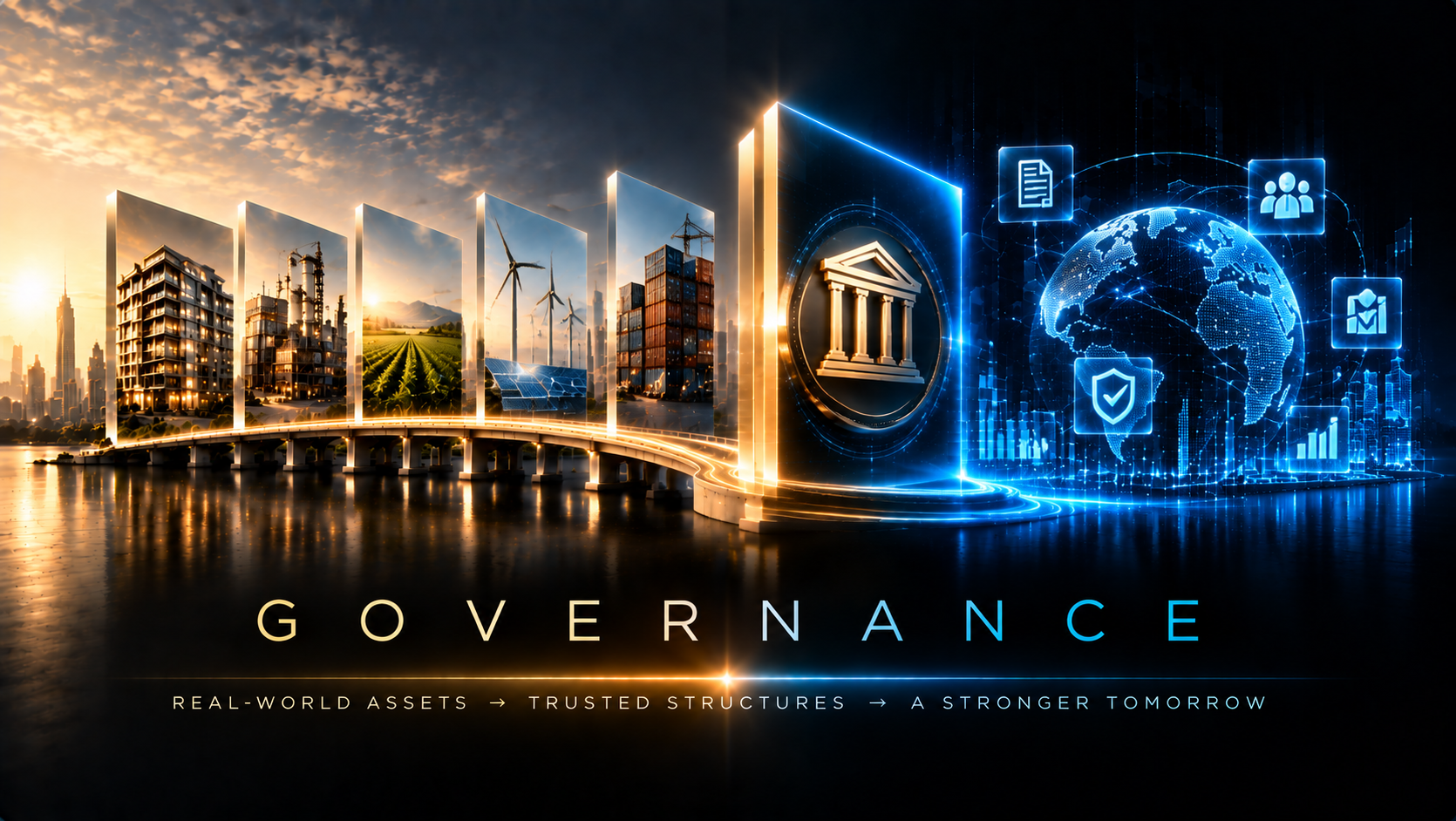
Governance Is Becoming Core Infrastructure for Tokenized Real-World Assets
Tokenization is evolving beyond digital representation.
As real-world assets increasingly move into blockchain-based environments, the market is beginning to focus on a more fundamental question: What does meaningful ownership actually look like once an asset is tokenized?
For Kyvera, this is one of the defining issues of the next stage of RWA tokenization. A digital token may represent an economic interest, but long-term adoption depends on the rights, governance, disclosures, recordkeeping, compliance controls and investor protections surrounding that token.
Developments throughout 2026 suggest that these elements are becoming increasingly important to institutional tokenization.
Ownership Must Extend Beyond the Token
In January 2026, the U.S. Securities and Exchange Commission outlined several structures for tokenized securities, distinguishing between issuer-sponsored models and third-party models, including custodial and synthetic structures. Importantly, the SEC noted that the rights associated with a token can differ depending on how the underlying security is structured and held.
This distinction matters far beyond publicly listed securities.
For any tokenized real-world asset, investors need clarity around fundamental questions:
What does the token legally represent?
What rights does the holder receive?
Who maintains the ownership record?
How are distributions handled?
How are decisions made?
What happens when ownership changes?
Technology can record transactions, but it does not answer these questions by itself.
Governance Infrastructure Is Moving Into Digital Markets
The market is already responding.
In 2026, Broadridge expanded its governance infrastructure across multiple tokenization models, enabling capabilities such as proxy voting, shareholder communications, regulatory disclosures and entitlement reconciliation for tokenized securities. Its infrastructure connects more than 200 million investor accounts globally.
In July, a custodial tokenization model for U.S. securities was launched in which underlying shares remained within traditional regulated custody while corresponding blockchain-based representations were issued. Governance infrastructure allowed eligible token holders to retain access to shareholder communications and voting mechanisms.
The wider significance is clear:
Tokenization is increasingly being designed to preserve the functions of ownership, not merely digitize the asset.
By August, similar governance infrastructure was being extended to other tokenized-equity frameworks, showing that voting rights and investor communications are becoming a broader market priority rather than an isolated feature.
Why This Matters for Real-World Assets
For real estate, private credit, infrastructure and other alternative assets, governance can be even more complex.
Consider tokenized real estate. Investors may need clarity on rental-income distributions, property management decisions, major capital expenditures, asset disposal, voting thresholds and transfer restrictions.
A blockchain can make ownership records more programmable. It cannot determine how ownership should be governed.
That structure must be designed before technology is implemented.
The same principle applies across the RWA ecosystem. Strong tokenization models require alignment between legal rights, commercial economics, technology, compliance and investor participation.
Regulation Is Reinforcing the Same Direction
The regulatory environment is evolving alongside market infrastructure.
On September 17, 2026, the SEC introduced a temporary conditional framework for qualifying venues facilitating trading of tokenized U.S. stocks. Among its requirements, tokenized shares must provide holders with rights and privileges equivalent to the corresponding traditional securities.
This reinforces an important market principle:
Digital innovation does not eliminate the importance of investor rights. It makes clearly defined rights even more important.
The Kyvera Perspective
At Kyvera, we believe governance should be considered at the beginning of the tokenization journey, not added after the token has been created.
Our orchestration approach connects five stages:
Asset Assessment → Strategic Structuring → Technology Enablement → Compliance & Governance → Investor Access
Within this framework, Compliance & Governance is directly connected to every other stage. The underlying asset determines what rights need to exist. Strategic structuring defines those rights. Technology must support them. Governance establishes how they are exercised. Investor access determines how those rights continue as ownership changes.
Kyvera remains platform agnostic because governance requirements should influence the technology architecture—not be constrained by it.
As tokenization matures, successful RWA ecosystems will increasingly be judged not only by how efficiently assets can be digitized, but by how clearly ownership, accountability and investor participation are structured.At Kyvera, we believe the future of digital ownership will be built on more than tokens. It will be built on trusted structures behind them.