

Introduction
Before issuing a token, asset owners must define investor rights, establish legal structures, assess compliance and assign governance responsibilities. Kyvera coordinates these foundations so digital ownership reflects a real-world arrangement.
Define the Asset and Investor Rights

What does a token holder actually own?
A token may represent a share in an entity, a contractual claim, a right to income or another defined interest. It does not automatically give its holder direct ownership of the underlying asset.
Before issuance, the documents should identify the asset and explain precisely which rights attach to each token. For a rental property, that includes who collects income, which expenses are deducted, when distributions may be made and what information investors receive. Transfer and exit rights also need clear terms. Kyvera helps asset owners align the proposed token with the rights investors can actually understand and exercise.
Establish the Legal Structure
Connect digital records to enforceable documents
The legal structure determines the relationship between the asset, its owner, the issuer and token holders. Depending on the arrangement, it may require a holding entity, asset transfer documents, investor agreements and a maintained ownership register.
The structure should also explain what happens if the asset is sold, the issuer becomes insolvent, a dispute arises or a technology provider fails. Those outcomes affect the value and reliability of investor rights. Kyvera coordinates the structuring process with qualified legal advisers so the digital record, contractual documents and practical operating model describe the same arrangement before tokens are issued.
Assess Compliance Before Distribution
Know the asset, audience and jurisdictions
Regulatory treatment depends on the rights a token provides and where it is offered. Before distribution, a project may need to assess securities rules, marketing restrictions, investor eligibility, identity verification, anti-money-laundering controls and disclosure requirements.
An online offering may also reach jurisdictions outside the issuer’s intended market. Eligibility checks and transfer restrictions should therefore be designed into the distribution process from the start. Kyvera brings compliance planning into the commercial and technical discussions early. IOSCO’s report on tokenization examines implications for market integrity and investor protection, including the need for clarity around token holders’ rights.
Set Governance Rules
Decide who has authority to act
Governance establishes who can make decisions once investors hold tokens. The documents should identify who may approve an asset sale, replace a manager, correct a record, resolve a dispute or respond to a breach.
They should also address voting rights, conflicts of interest and how decisions are communicated to investors. Smart contracts can execute defined instructions, but unexpected events still require accountable people and agreed procedures. Kyvera helps coordinate these responsibilities before issuance so that technology reflects a workable governance model. The Financial Stability Board has also examined operational and financial stability risks associated with tokenization.
Design for Ongoing Obligations
Plan beyond the launch
Issuing tokens begins an operating commitment. Asset owners may need to provide financial reports, valuation updates, distribution records, tax information and responses to investor questions. They also need procedures for changes in asset performance, ownership information or applicable requirements.
These duties should have named owners, reliable data sources and realistic schedules. Otherwise, an offering may promise information or processes that the operator cannot consistently deliver. Kyvera considers ongoing administration while the structure is being designed, helping asset owners connect investor expectations, legal obligations and technology capabilities to the people who will manage the asset after launch.
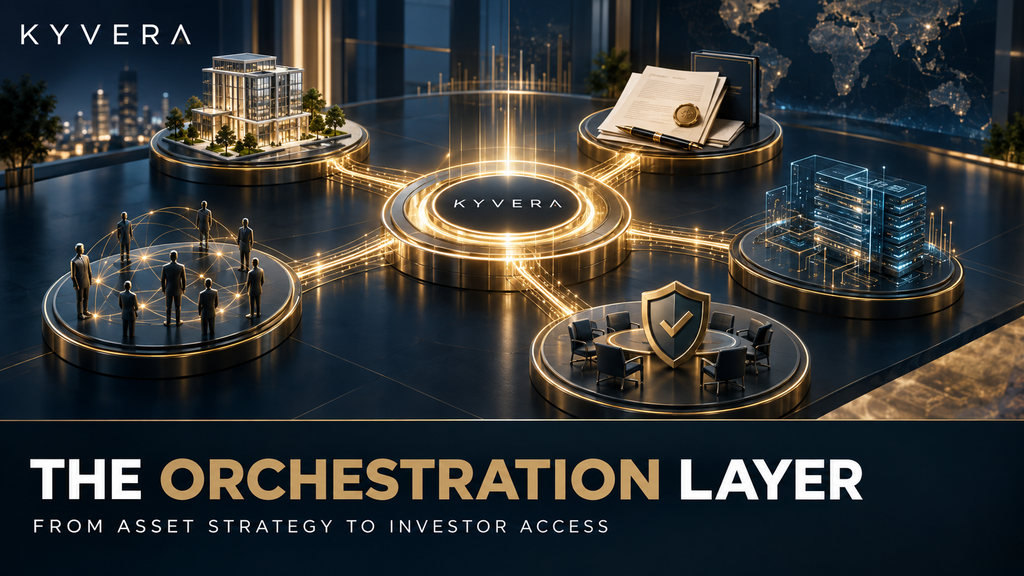
Kyvera’s Orchestration Layer
Kyvera positions itself as the Orchestration Layer for the future of ownership. Its role is to coordinate the decisions and specialists involved before a tokenization project reaches issuance.
That work connects asset evaluation, commercial and legal structuring, technology selection, compliance and governance planning, and potential investor access. Each decision informs the next: the asset and investor rights shape the legal documents, which guide platform requirements and distribution controls. Kyvera helps keep those elements aligned around one asset strategy. Qualified advisers remain responsible for their specialist work, while Kyvera helps the owner maintain a coherent path from assessment to execution.
Market Statistics
RWA.xyz tracks several measures of tokenized assets. The figures below are the figures provided in the original draft; a dashboard capture date was not supplied, and I could not independently confirm these live values. They should be checked on the RWA.xyz overview immediately before publication.
| RWA.xyz measure | Figure in original draft |
| Distributed asset value | US$38.82 billion |
| Represented asset value | US$364.76 billion |
| Total asset holders | 4,352,176 |
These measures describe different things and should not be added together or presented as one market-size estimate. RWA.xyz distinguishes distributed assets from represented assets. For a specific issuance, the practical question remains whether its rights, governance and distribution arrangements are sound.
FAQs
Can a project decide its legal structure after issuing tokens?
The legal structure should be established first. Investors need to know what rights they receive and which documents support those rights before they subscribe.
Does blockchain prove ownership of the underlying asset?
A blockchain can record token holdings. The governing documents and applicable law determine what enforceable claim, if any, those holdings provide.
Why does governance matter if transactions are automated?
People still need authority to handle valuations, disclosures, disputes and unexpected events. Automation can carry out defined processes; governance determines who is responsible when judgment is required.
Conclusion
A credible real-world asset token needs clearly defined rights and a structure that can operate throughout the asset’s life. Establishing compliance, legal arrangements and governance before issuance helps investors understand their position and gives operators a practical basis for managing the offering.
The work continues after launch through reporting, distributions, recordkeeping and decisions about changing circumstances. Kyvera’s Orchestration Layer helps asset owners coordinate these connected requirements with the relevant specialists. By starting with the asset and its obligations, Kyvera helps ensure that any token issued represents an arrangement that is clear, administrable and built to function beyond launch.