
Beyond Tokenization: Why Liquidity Infrastructure Is Becoming Critical for Real-World Assets
The real-world asset market is reaching an important turning point.
For years, much of the tokenization conversation focused on a basic question: Can traditional assets be represented on-chain?
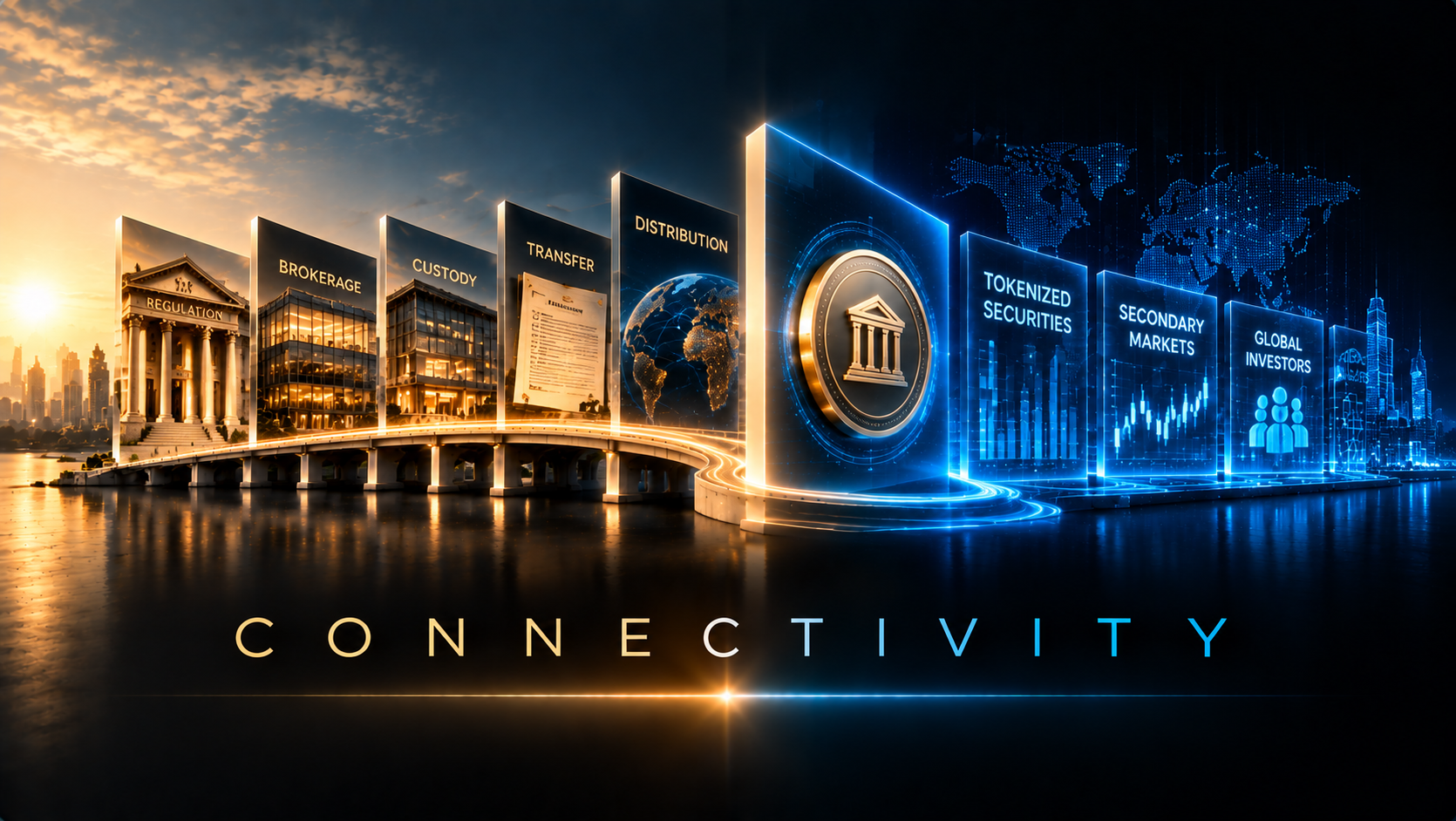
In 2026, the market is moving beyond that question. The challenge now is building the infrastructure that allows tokenized assets to move, trade, settle, interact with investors, and connect with their underlying real-world value efficiently.
At Kyvera, we believe this shift is critical. Creating a token is only the beginning. For tokenization to become meaningful at scale, the ecosystem surrounding the asset must work just as effectively as the technology representing it.
Liquidity Is Moving to the Center of the Conversation
The market data reflects this evolution.
By the end of August 2026, the total on-chain tokenized RWA market had reached a record $34.7 billion. Tokenized stocks and equities alone reached approximately $4.45 billion, growing 11.3% during the month and becoming the third-largest tokenized asset category. On-chain tokenized-equity trading volumes were approaching $10.6 billion for August.
These numbers are market snapshots rather than permanent values, but the direction is significant: investors are not simply holding tokenized assets. Market infrastructure around those assets is becoming increasingly active.
One recent example came in September, when institutional infrastructure was introduced allowing approved institutions to convert existing traditional shares into corresponding tokenized positions and redeem those tokens back into underlying shares.
For Kyvera, the larger lesson is more important than any individual platform:
Effective tokenization requires a credible connection between the digital asset and the underlying economic value.
Tokenization Does Not Automatically Create Liquidity
One of the biggest misconceptions surrounding RWAs is that putting an asset on blockchain automatically makes it liquid.
It does not.
Liquidity depends on a much broader ecosystem: investor demand, valuation, transferability, market access, custody, settlement infrastructure, regulatory permissions and mechanisms for entering or exiting a position.
This distinction becomes particularly important for real estate, private credit, infrastructure and other traditionally less-liquid assets.
A property cannot simply be transferred between markets in the same way as a publicly traded share. Its ownership structure, investor rights, income distributions, governance arrangements and transfer restrictions need to be defined before technology can meaningfully improve accessibility.
Market Infrastructure Is Catching Up
Institutional infrastructure is also evolving rapidly.
DTCC is preparing to launch its Tokenization Service in October 2026, designed to connect DTC-held traditional securities with blockchain environments while retaining existing ownership rights and investor protections. DTC currently custodies more than $114 trillion in assets.
Regulatory infrastructure is evolving alongside it. On September 17, 2026, the U.S. SEC introduced a temporary conditional framework allowing qualifying venues to facilitate limited trading of tokenized NMS stocks through permissioned on-chain environments and liquidity pools. Importantly, qualifying tokenized stocks must provide holders with rights and privileges equivalent to the corresponding traditional shares.
Together, these developments point toward a market where technology, regulated infrastructure and liquidity mechanisms increasingly need to operate together.
What This Means for Asset Owners
For Kyvera, this reinforces why tokenization should start with strategy rather than technology.
Before an asset moves on-chain, asset owners should understand:
What is being tokenized?
What rights will investors receive?
How will value be determined?
How can investors enter and exit?
What transfer restrictions apply?
Which infrastructure will support custody and settlement?
Where will investor access come from?
These questions shape whether tokenization produces a functional asset ecosystem or simply a digital representation.
The Kyvera Approach
Kyvera approaches RWA tokenization through five interconnected stages:
Asset Assessment → Strategic Structuring → Technology Enablement → Compliance & Governance → Investor Access
Our platform-agnostic orchestration model allows the technology and ecosystem to be selected around the requirements of the asset—not the other way around.
As tokenized markets mature, liquidity will increasingly depend on how effectively these layers connect.
The future of RWA tokenization will therefore not be defined simply by how many assets move on-chain.
It will be defined by whether those assets have the structure, infrastructure, connectivity and investor pathways required to function in a digital market.
At Kyvera, we believe that is where tokenization moves from representation to real utility.