
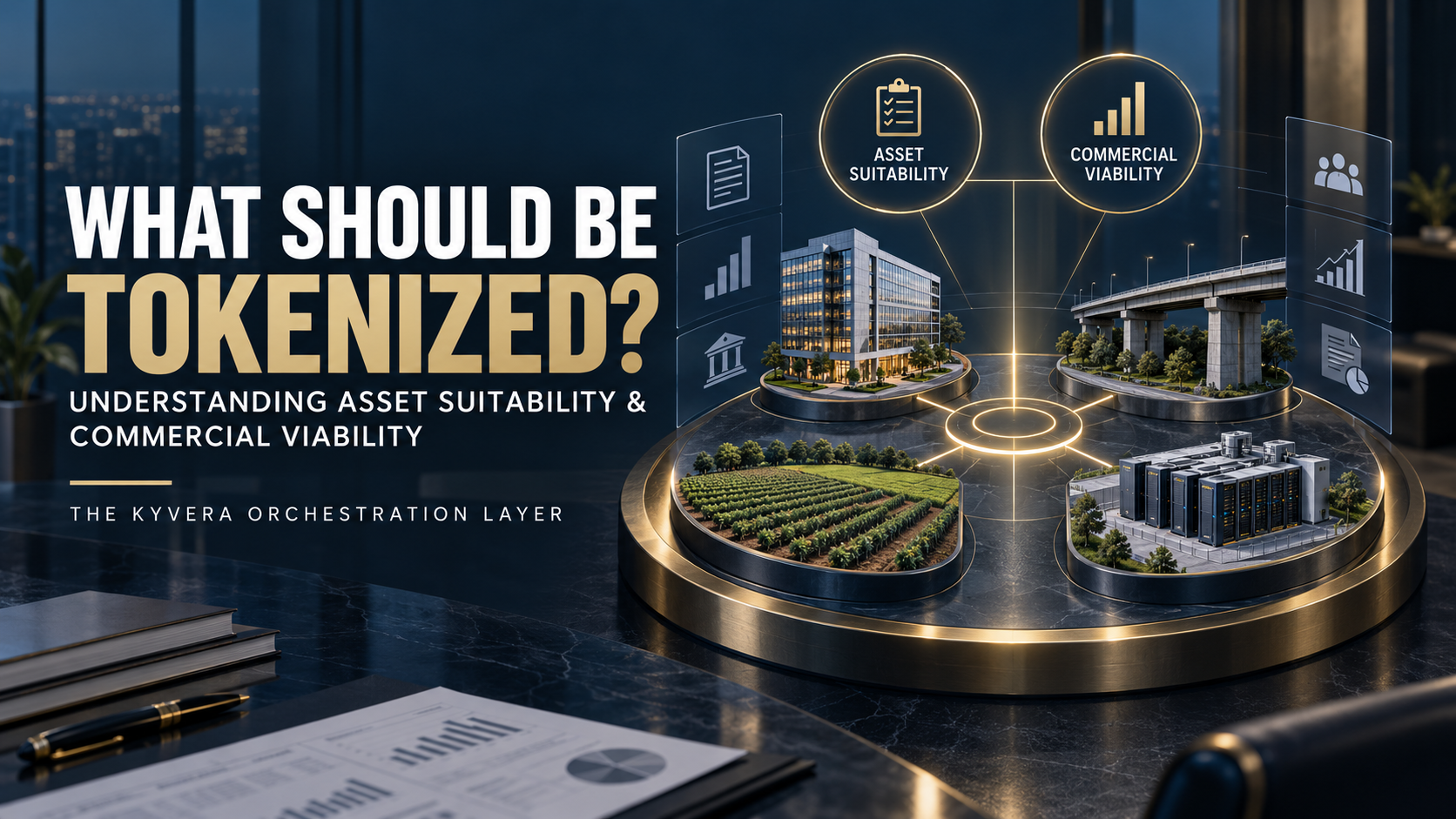

What Makes an Asset Suitable for Tokenization?
Not every valuable asset is suitable for tokenization. A high-value property, profitable business, or attractive opportunity requires careful evaluation before becoming a structured digital asset.
Asset suitability begins with clarity.
Before tokenization, asset owners must understand:
- Who owns the asset?
- What rights will the token represent?
- How will the asset generate value?
- Can the structure operate effectively?
Clear ownership records, reliable valuation, defined economic rights, and transparent financial information create the foundation for successful tokenization.
Tokenization does not improve a weak asset proposition. It creates value when the underlying asset already has strong commercial fundamentals.
Kyvera approaches tokenization as a strategic and commercial decision. Kyvera helps institutions evaluate whether an asset is suitable, identify potential gaps, and develop a structured pathway before execution.
Which Assets Are Worth Assessing?
Real Estate and Infrastructure
Real estate and infrastructure assets are among the most explored categories for tokenization because they often have measurable value and defined economic potential.
However, suitability depends on:
- Ownership documentation
- Property rights
- Valuation support
- Operating costs
- Legal structure
- Investor participation model
Kyvera evaluates these foundations before considering digital representation.
A commercial property may have significant value, but successful tokenization requires clarity around ownership, income distribution, management responsibilities, and investor rights.
Agriculture and Natural Resources
Agricultural assets and natural resources require detailed assessment because they involve operational complexity and market variables.
Important factors include:
- Production records
- Operating partners
- Environmental considerations
- Market conditions
- Revenue stability
Kyvera evaluates whether these assets have reliable economic foundations and operational structures required for responsible tokenization.
Data Infrastructure and Corporate Assets
Data centres, equipment, receivables, and other corporate assets may also represent potential tokenization opportunities.
Kyvera assesses:
- Enforceable rights
- Counterparty quality
- Reporting systems
- Asset lifecycle
- Commercial sustainability
The strongest candidate is not always the most popular asset category. It is the asset with clear rights, credible economics, and a workable structure.
Commercial Viability: Will the Structure Make Business Sense?
An asset may be legally suitable and technically possible but still fail commercially.
Before tokenization, organizations should evaluate:
- Expected benefits
- Structuring costs
- Compliance requirements
- Technology expenses
- Administration needs
- Investor demand
Kyvera helps institutions determine whether the expected value justifies the resources required for implementation.
Liquidity also requires careful consideration. Tokenization can improve ownership management and transfer processes, but it does not automatically create an active resale market.
Kyvera evaluates investor demand, distribution strategies, and practical transfer limitations alongside the asset’s potential returns.
Commercial success also depends on execution capability. Asset management, reporting, investor communication, and ongoing operations must be clearly defined.

An Illustrative Assessment Table
The following framework represents an illustrative assessment model, not market statistics or investment predictions. Kyvera adjusts criteria according to each asset and proposed structure.
| Assessment Area | Weighting | Core Question |
| Ownership and Rights | 25% | Are ownership and participant rights clearly documented? |
| Financial Records and Valuation | 20% | Can value and potential returns be verified? |
| Investor Demand | 20% | Is there a suitable audience for the opportunity? |
| Legal and Compliance Feasibility | 20% | Can the structure meet applicable requirements? |
| Operations and Reporting | 15% | Can the asset be managed consistently? |
A strong result in one category cannot compensate for a critical weakness in another. For example, investor interest cannot resolve unclear ownership.
Kyvera uses assessment frameworks to identify challenges and determine the appropriate next steps.
Frequently Asked Questions
Does a high-value asset automatically qualify for tokenization?
No. Value alone is not enough. Ownership clarity, investor rights, governance, financial records, and market demand must also be evaluated.
Does tokenization create liquidity?
Not automatically. Liquidity depends on the structure, regulations, investor participation, and availability of buyers.
What should asset owners prepare before approaching Kyvera?
Owners should prepare ownership documents, financial records, valuation information, agreements, and a clear commercial objective.
Kyvera uses this information to assess readiness and identify required actions.
Conclusion
The most suitable assets for tokenization are those with clear rights, credible economics, strong governance, and a defined commercial purpose.
Successful tokenization requires more than selecting technology. It requires strategic assessment, structured planning, and coordinated execution.
Through the Kyvera Orchestration Layer, Kyvera helps institutions evaluate asset suitability, test commercial viability, coordinate stakeholders, and create responsible pathways from real-world assets to digital opportunities.The right asset, supported by the right strategy, creates the foundation for successful tokenization.